Wartime squadron leader, aged 94, chalks up £11,500 victory over Peverel

Sins of commission … and omission: Strand Court in Rye, where Peverel doled out contracts to Cirrus and Kingsborough without telling the residents that they were related companies

Eric Mathews, still dealing with irritants aged 94

During the Second World War, when Eric Matthews, 94, was an RAF squadron leader, he was used to chalking up downed enemy aircraft. Now he is celebrating another victory over a lesser adversary: Peverel, which has had to pay back £11,475.34p.

The money is being re-paid after a series of inter-company deals by the property management company at Strand Court in Rye, East Sussex.

Peverel was criticised by the tribunal for treating the residents with “arrogance” and for “the intentional hiding of information to which residents would have been entitled” by doling out contracts to their own subsidiaries.

Excessive commission paid to Peverel’s insurance company Kingsborough accounts for £8,029.36p of the ruling, while a new emergency call and door system – fitted by Peverel’s sister company Cirrus, and of questionable value  – involved a re-payment of £3,445.98p.

At one point, commissions charged by Kingsborough exceeded 33 per cent.

Eric Matthews saw Neville Chamberlain promise ‘peace in our time’ in 1938 … only to have precious little of it at Strand Court

“This was an excellent win over a company who thought they were dealing with a group of elderly ladies who would not dare make a fuss,” says Matthews, who as a young air traffic controller watched Neville Chamberlain in 1938 land at Heston airport after meeting Hitler, wave a piece of paper and promise “peace in our time”.

He was assisted in the action by solicitor and former university lecturer Archie White, in his mid-eighties, who was the fellow applicant on the Leasehold Valuation Tribunal action. Another resident, Mary Smith, in her sixties and a local councillor, provided the back-up team.

The respondent in the case, as always, was the freeholder, Proxima GR Properties Ltd, part of the Tchenguiz Family Trust, but the issues concerned Peverel. It was given its marching orders from the site, which had exercised “right to manage”, in November 2011, and the bills were run up in 2005-2011.

[Read more...]

Janet Entwistle: ‘Problems with Peverel’s reputation, but we are in it for the long term’

Janet Entwistle has published a digest of the questions and answers either emailed to her or asked at her public meetings with Peverel’s leaseholders on June 12.

The comments are a frank admission that the company has “problems of reputation” and address fraught issues such as insurance commissions, sub-letting fees and service charges – subjects that have been raised repeatedly on critical websites.

The dialogue is a far deeper engagement with leaseholders than many were expecting when the meetings were announced.

Peverel was bought from administrators three months ago by the private equity firms Chamonix and Electra, and Entwistle was appointed chief executive. She says they are “in it for the long term”.

The Q&As are published on the Peverel website:

http://www.peverel.co.uk/news/questions-from-the-customer-forums/1

A selection are reproduced (unedited) here:

Q: How will you rebuild Peverel’s reputation so people feel confident buying properties in the developments you manage?

A: I recognise there are problems with the reputation, but we are not here to just look at changing the brand.  That isn’t a long term solution.  What we need to do is make sure that the customer service gets better. This is the best way to change people’s perceptions of Peverel.

[Read more...]

Executive guilty of plundering £122,000 from managing agents Rendall and Rittner

An executive with managing agents Rendall and Rittner pleaded guilty on Monday to stealing £122,000 from his employers’ accounts.

Simon van Houten, 31, from Southend in Essex, used bogus company invoices to scam the company, which manages some of the most prestigious residential buildings in London.

Van Houten, a parish councillor at Paglesham, carried out the fraud over two years before he was rumbled.

He pleaded guilty just before the trial began at the Old Bailey on Monday, and is now awaiting sentencing on July 26.

The case is a reverse for Rendall and Rittner, which has been on a roll this year. It recently won the management of several prestige developments for the Berkeley Group and Redrow’s One Commercial Street, just east of the City. It also manages the upmarket eco resort the Lower Mill Estate in the Cotswolds.

Only last month Rendall and Rittner won a Property Week Resi award for turning round St George’s Wharf, built by the Berkeley Group, where residents received £1 million last September in settlement for over-charging. The complaints occurred when the site was under previous management.

The company, which is FSA regulated, is run by ex-barrister Duncan Rendall, a former chairman of ARMA, and Matt Rittner.

LEASE denies seeking bungs to pass ordinary leaseholders on to professional services

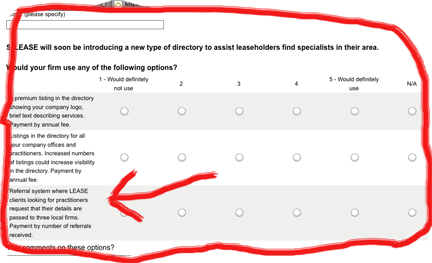
LEASE, the Leasehold Advisory Service, is a taxpayer-funded quango, so why on earth is it asking solicitors and others whether they would be prepared to pay referral fees to be put in touch with the distressed ordinary leaseholders who call up for advice?

Referral fees – or ‘bungs’ as they are less politely termed – are rife in the property world, but it is astonishing that a government agency considered accepting them.

LEASE says it does not accept referral fees, nor will it do so in the future.

Had it done so, LEASE would have been handing over leaseholders with serious legal or other problems to solicitors, managing agents, surveyors etc not because these firms have any particular merit, but because they had made a payment to the advisory service.

The evidence that LEASE was considering referral fees comes in the form of an emailed survey following the lavish ‘annual conference’ the quango held at a Mayfair hotel on May 15.

This was, in fact, a very expensive trade fair filled with representatives from RICS, ARMA, large-scale managing agents, landlords, solicitors and barristers.

[Read more...]

Janet Entwistle: ‘There are problems with Peverel’s reputation, but new owners are in it for the long term’

Janet Entwistle has published a digest of the questions and answers either emailed to her or asked at her public meetings with Peverel’s leaseholders on June 12.

The comments are a frank admission that the company has “problems of reputation” and address fraught issues such as insurance commissions, sub-letting fees and service charges – subjects that have been raised repeatedly on Carlex.

Peverel was bought from administrators three months ago by the private equity firms Chamonix and Electra, and Entwistle was appointed chief executive. She says they are “in it for the long term”.

The Q&As are published on the Peverel website:

http://www.peverel.co.uk/news/questions-from-the-customer-forums/1

A selection are reproduced (unedited) here:

Q: How will you rebuild Peverel’s reputation so people feel confident buying properties in the developments you manage?

A: I recognise there are problems with the reputation, but we are not here to just look at changing the brand.  That isn’t a long term solution.  What we need to do is make sure that the customer service gets better. This is the best way to change people’s perceptions of Peverel.

Q: Where does Estates & Management fit into the Peverel structure?

A: Estates & Management is not part of the Peverel Group. It is a company that acts as an agent for the landlord of some of the properties we manage and is owned by Consensus Business Group, part of the Tchenguiz Family Trust (TFT) and previously we were also owned by TFT. We do manage many of its developments still, but on a commercial basis – just as we manage developments for Berkeley Homes, Barratt Homes and other housebuilders.

[Read more...]

Managing agents owned by landlords must come clean … says leading managing agent

A managing agent owned by the freeholder should be made to disclose this relationship clearly to the leaseholders, one of the country’s leading managing agents has announced.

“They should be obliged to disclose if they have, or any party to whom they are financially connected has, any beneficial interest in the freehold title,” says Rob Plumb (left), chief executive of HML Holdings plc.

“Such a relationship clearly gives rise to doubts about their impartiality.”

Plumb’s comments appear in a letter in response to the London Assembly’s continuing investigation into leasehold service charges. In March it issued a report, Highly Charged, which was critical of “opaque” charges and claimed that leasehold complaints had increased by more than 50 per cent in ten years (more here)

The letter has also been forwarded to the Association of Residential Managing Agents and the Leasehold Knowledge Partnership. HML manages 35,000 residential properties.

[Read more...]

TV documentary on retirement industry needs help

A journalist working on a story about the retirement home industry would like to hear from people that have bought a leasehold retirement apartment built after 2009.

All information will be dealt with in strict confidence, please get in touch:

sok@leaseholdknowledge.com 07808 328 230

First task for ARMA’s ethical panel: examine ARMA itself

The Association of Residential Managing Agents is seeking to brush up its act by appointing a chairman and members for the disciplinary panel of its “new self-regulatory regime”.

It was advertising the posts in yesterday’s Sunday Times.

This is an attempt by the trade body to regain credibility after its long years of silence when numerous LVTs made rulings against its own members.

No managing agent has ever publicly been expelled from the organisation, and it is unclear whether the new system, when it is unveiled, will keep disciplinary hearings confidential.

“The independent regulator would determine disciplinary cases brought before the panel,” says ARMA.

So here is a first complaint – against ARMA itself.

Why is the annual conference of this trade body being sponsored by an outfit called Energy Renewals, which is offering “ongoing admin payments” of up to £250,000 to managing agents?

These payments are rewards for spending other people’s money in the form of energy contracts and can go straight into the pockets of managing agents, or freeholders, without leaseholders knowing a thing about them.

Energy Renewals says that the payments would typically be between £3,000 and £50,000 a year.

Major corporate clients – presumably the largest national managing agents – can do better still with payments of £50,000 to £250,000.

Leaseholders would not have to be told anything about these payments.

How does this sort of sponsorship tally with ARMA’s enthusiasm “to make a difference to the lives of the thousands of people who live in leasehold flats by raising standards and promoting customer service”, as its advert in yesterday’s Sunday Times puts it?


Full story on Energy Renewal offer, Bungs ‘r’ Us, can be read here

Sub-letting: LKP trials a simple scheme that benefits all

Around forty quid is what you should be paying for leasehold sub-letting fees to landlords, following this case in February 2012.

Invariably, sub-letting fees are seen as a little earner by landlords, although for the large landlord companies the £100-£130 fees, plus £75 for registration add up to a tidy sum.

Leasehold flat owners renting out their properties often decline to pay up. But it is reasonable that the freeholder and, even more important, the managing agent knows who is actually living in a flat.

As a result, Leasehold Knowledge Partnership has begun work on producing a new sublet agreement template that aims to benefit all parties.

After all, everyone would benefit if new tenants actually knew what the basic rules of a block are. Similarly, the managing agent may need to contact the tenant, flat owner or letting agent at any particular time, and these details should be available.

Leasehold Knowledge Partnership is now testing the first pilot scheme for a new system and will report on the results within the month.

In the meantime, please send in your views on what should be included in a simple sublet agreement.

Email: sok@leaseholdknowledge.com

Sub-letting fees should not be more than £40, landlords are told (four times by the Land Tribunal)

In monetary terms sub-letting fees are one of the more trifling little earners in the leasehold game, but they are deeply resented by flat owners who see that landlords do almost nothing for their money.

Now, it seems, the Land Tribunal agrees with them, ruling in four cases that sub-letting fees should be around £40.

Anyone involved in a dispute with a landlord could offer this sort of sum and be in with a fair chance that that would be the end of it.

Sub-letting fees vary, but charges of £100 – £135 are common, and then there are registration fees of around £75.

Four appeal cases were brought by landlords to the Land Tribunal last February and they were heard together by George Bartlett, QC, president of the Upper Tribunal.

Two appeals were brought by our old friends Peverel, this time trading as Holding and Management (Solitaire) Ltd.

One concerned  a Barratt £123,295 flat in Essex, where the owner was being charged of £105 for this (as well as £75 for the preparation of a deed of covenant and £75 for registration).

The other a £104,500 Barratt flat in Reading, which was being rented out under an assured shorthold tenancy agreement for £750 per month. Solitaire wanted a £135 fee for consent and a notice fee of £75.

Another case, brought by Samnas Ltd, concerned a £122,000 flat in Banbury, Oxfordshire, where the company was after £105 , as well as £75 for registration of the sub-letting.

The last was in Milton Keynes and concerned a £166,000 property where Flambayor Ltd was after £135, and  £75 for the registration.
[Read more...]

Bungs ‘r’ Us: £250,000 ‘incentive payments’ offered to managing agents

A company offering bungs to managing agents if they sign up for new gas and electricity supplies is being touted to … all the members of the Association of Residential Managing Agents!

An outfit called Energy Renewals is offering what it politely terms “incentive payments” of between £3,000 and £50,000 a year.

Major corporate clients – such as the larger, national managing agents – can do better still with payments of £50,000 to £250,000.

And the brilliant thing about it is that the leaseholders don’t have to be told anything about these payments and can be relied upon to keep paying up in blissful ignorance.

The incentives – which are rewards for spending other people’s money – can go straight into the pockets of managing agents, or freeholders.

[Read more...]

£30,000 bill for RTM ‘fiasco’

A group of 120 leaseholders in Brighton have failed in their bid to win “right to manage” and have been left with a legal bill of more than £30,000.

The RTM company set up at Kingsmere, a Seventies building on the London Road in Brighton, has only £800 left in the accounts and faces going into administration.

“We have been completely let down by lawyers and by the Leasehold Valuation Tribunal process,” says John Deacon, chairman of the residents’ association and the RTM company.

[Read more...]

Charter Quay: LVT’s devastating criticism of Tchenguiz/Peverel management

Most critical LVT ruling ever made?

This piece is a report of the staggering Leasehold Valuation Tribunal victory at Charter Quay in November 2011.

It is the most devastating criticism of the Tchenguiz/ Peverel modus operandi to be aired and judged in open court.

The full LVT ruling can be read here:

CHARTER QUAY LVT

The LVT ruling in November 2011 is perhaps the most damning one ever made at an LVT.

November 27 2011: Property tycoon Vincent Tchenguiz and the property management group Peverel have been involved in a second massive defeat at a Leasehold Valuation Tribunal in as many months.

After the humiliation of a record £1 million pay-out to residents at ritzy St George’s Wharf in Vauxhall in September, last week Peverel’s legal team lost another £185,000 to leaseholders at Charter Quay in Kingston, Surrey.

The devastating Leasehold Valuation Tribunal ruling was unusual in the strength of language used to criticise managing agents County Estate Management, a Tchenguiz company of which Peverel took over operational control in summer 2008.

County Estate’s conduct was denounced as “disgraceful” for loading management fees, doling out contracts to other Tchenguiz-owned companies and loading the cost of insurance brokering.

Terms like “glaring failure” and “unacceptable behaviour” appear in the judgment.

The tribunal was astonished that between the Tchenguiz-owned landlord and the Tchenguiz-owned managing agents “there appears to have been no formal written contract appointing them at all”.

The tribunal contemptuously dismissed the obfuscated company ownership structure of the Tchenguiz family trust, with companies ultimately based in the British Virgin Islands. These were termed “quasi Biblical” in their length and complexity.

[Read more...]

Stop this ‘legal torture’ of pensioners, says MP

Sir Peter Bottomley denounces LVT stratagems in post on LKP

Sir Peter Bottomley attacks “relentless money-grabbing opponent”

A senior Tory MP has posted on LKP today to express his utter disgust at the delaying tactics used by the freeholder  – whose lawyers included Laceys, who proclaim themselves the “honorary solicitors” of ARMA – at the Oakland Court LVT earlier this month.

Sir Peter Bottomley, MP for Worthing West, claimed that this amounted to “legal torture” and he condemned the entire LVT process, referring to “the series of actions and expensive stratagems faced by elderly frail constituents without the financial resources to play unending tribunal games with a relentless money grabbing opponent”.

The £137,000 action [see below] was won by the 40 pensioners, but two of the original applicants died and three went into care before the LVT was heard.

[Read more...]

How you get scammed on insurance … with tips from LEASE!

It is a brilliant (not-so-little) earner and one that – astonishingly – isn’t illegal.

Buy up residential freeholds, charge enormous commissions for arranging the insurance and pass the bill on to leaseholders, who – and this is the really brilliant bit – have no legal right whatsoever to find out what the commissions are.

The Sunday Times earlier this week recommended that the wealthy buy up freeholds for the ground rents, adding: “Additional income comes from commissions for arranging building insurance …”

In fact, loading the insurance is the best gig in town.

[Read more...]