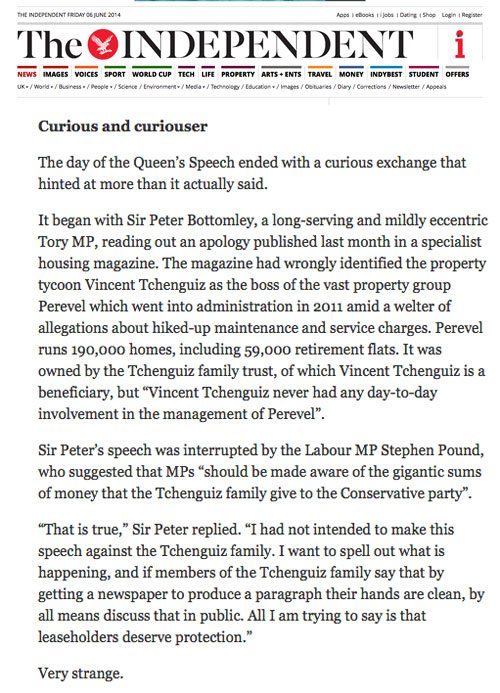
Ex-Israeli intelligence operatives settle dispute with Tchenguiz

The spectacle of Vincent Tchenguiz publicly falling out with his team of former Israeli intelligence operatives has come to an end, with the latter describing themselves as “very happy” with the settlement.

Black Cube launched an action against Tchenguiz in the UK for £330,000 plus interest for work carried out for the tycoon following his arrest by the Serious Fraud Office in March 2011. It also claimed that it should have been paid one per cent of any successful litigation initiated by Tchenguiz and have a cut in a movie deal about Tchenguiz’s arrest.

Details about “Tchenguiz: The movie” are tantalisingly sketchy, however.

The tycoon, who controls one per cent of residential freeholders and used to own Peverel, the country’s largest property manager, is after £300 million compo – with his brother Robert – from British taxpayers.

Last week, in the House of Commons Sir Peter Bottomley, Tory MP for Worthing West, said: “I would have thought that a handshake and an apology would solve that,” adding ominously that “A whole series of other issues should, I believe, be fully examined under parliamentary privilege.” [Read more...]

Small claims court exit fee battle fails … but it has cost Fairhold thousands

SUSANWOOD2Susan Wood (left) failed in her court struggle earlier this week to be reimbursed the £1,150 in exit fees paid when her late father’s retirement leasehold flat was sold in 2010.

Wood, a long-standing activist with the Campaign Against Retirement Leasehold Exploitation (Carlex), argued that as the fee was for a service that was not carried out – ostensibly to vet the capability of the flat’s purchaser for “independent living” – she should receive the money back.

Exit fees have long been a source of controversy in retirement leasehold. The Office of Fair Trading believe them to be unfair, but has not ruled against them, and McCarthy and Stone, which included them in its leases for years, now declines to enforce them (although as it has sold almost all its freeholds this is of little practical importance).

The issue was heard on January 2 in the small claims division of Sheffield County Court, but Fairhold, a freehold owning company within the Tchenguiz Family Trust, was taking no chances.

Barrister Paul Letman ... has form with lay applicants

Barrister Paul Letman

Barrister Paul Letman was sent up from London to fight the case, which may have cost many times more than the sum disputed.

Wood gave a polished outline of her case, which rested on the simple point that she had been charged for something that had not, in fact, been done. Only if this argument failed did she ask the court to rule that the transfer fee represented an “unfair term” under consumer contract legislation.

But Letman successfully argued on points of law that the lease did not say that the transfer fee was a fee for a service, nor did this represent an unfair contract term.

[Read more...]

Grant Thornton had ‘direct interest’ in the Tchenguiz arrests, which should have been revealed

Vincent Tchenguiz at court, with his support team

Accountants Grant Thornton “had direct interest” in the arrest of Vincent and Robert Tchenguiz in March 2011 which should have been known about beforehand.

This conclusion has been overlooked in the media coverage of yesterday’s High Court ruling into the debacle of the Serious Fraud Squad’s handling of the investigation.

The judicial review into the arrests, where the Tchenguiz were represented by Lord Goldsmith, a former attorney general, and Lord MacDonald, a former Director of Public Prosecutions, runs to 64 pages and is perhaps the most costly prose to have been published this year.

The SFO “relied very heavily on the work and conclusions of Grant Thornton”, according to the High Court, but when search warrants were authorised  by Judge Paul Worsley, he was told “nothing about the role of Grant Thornton in the allegations”.

The judge should have been “alert to any possibility that the SFO was being used to promote the interests of one party to civil litigation”.

[Read more...]

Baroness Hanham and Rupert Murdoch: spot the difference

One is parroting the non-policy of Grant Shapps, and the other has never met him or, if he has, asked no favours


By ‘Barrack-room Lawyer’

(As ARHM president Baroness Greengross defined OAP complainers in retirement flats with too much time on their hands)

In last Monday’s House of Lords debate, initiated by Baroness Gardner of Parkes following meetings with LKP, a number of important issues faced by the leasehold sector were raised.

They were rebutted by the Government Minister Baroness Hanham, of the Department of Communities and Local Government, who insisted that everything is balanced and that the vast majority of leaseholders are “satisfied”.

She went on to claim that the Leasehold Valuation Tribunal service is now nothing to do with her department, and tells us that it is the leaseholders’ responsibility to ensure that there is nothing onerous in the lease. (And you thought that’s what you employed a solicitor for and why we had laws to protect us!)

For many years, Hanham – and her predecessors -– have been able to rely on leaseholders not fully understanding  the complexities of this form of tenure, which she admits is a complex issue.

As a result, many a Murdoch like statement on leasehold is thrown in the leaseholders direction. The Baroness is able to claim evidence where none exists and, conversely, to claim no knowledge on issues well known to her department.

I would like to correct some of the errors in her statement to the House.

‘Leaseholders are satisfied’

“We believe and understand that most leaseholders are, in fact, satisfied not only with their property but with the way it is managed. “

This is not true. Baroness Hanham and her department have absolutely no data to support this claim in much the same way that Housing Ministers Grant Shapps has absolutely no data to support his claim there is “balance” in the current legislation.

On the contrary, her department is fully aware that Which Magazine asserted late last year that more than £700 million is being overcharged each year in service charges, and that only a tiny percentage of that money is ever recovered by leaseholders through the LVT.

The department is also fully aware of the London Assembly report, Highly Charged, adopted by all parties in Assembly, as recently as March 2012, which says there are serious problems with leasehold. The report’s title would surely have given the minister a clue?

“We have a statutory framework in place that aims to balance the different parties’ interests in the same property,” she says. “The goal is to provide leaseholders with the rights and protections they need, while recognising the legitimate interests of landlords. “

Again the Baroness and her department have absolutely no data to support this claim and appears to ignore all the data which suggests a wholly different position applies.

“Service charges are an issue. All sorts of issues have been raised today about the protection of money and service charges, how much they are and what is involved with them.

“Again, I am afraid that that is a matter for the leaseholders to watch carefully.”

Hanham fails to mention that Grant Shapps abandoned legislation that would have protected leaseholders’ funds when he assumed office in 2010.

Leaseholders have few rights to “watch carefully”. Her department is also fully aware that there have been a number of instances where monies have disappeared and that there is little that can be done to recover the losses.

“It is important that what the managing agents do, and the costs that they put forward, are transparent, and that the leaseholders have a number of rights. They can and must ask for a summary of service charges, and those charges should be consulted upon.

“They must be able to see the supporting documentation. They have a right to see insurance documents and the right to have a management audit carried out, albeit at their own expense. So they have some control over the service charges, although I think my noble friend Lady Miller mentioned capital charges and the fact that some people had not understood that they were going to come in.”

‘Good codes of practice’

Hanham fails to point out that her department is fully aware that due to the complexity of the legislation few of these rights can be exercised.

Many sites receive their accounts years after payment and can take no action at all. Many sites also do not qualify for a number of the “rights” she lists.

To obtain a management audit, leaseholders must have 66 per cent of owners signed up to fund the audit. In many large modern developments with a high buy-to-let investor ownership, finding 30-40 per cent of owners can be impossible let alone finding 66 per cent!

Because of the difficulty of finding owners many sites do not have a legally recognised tenants’ association and, perversely, the legal guidance provided by Hanham’s department states that you need more members to become a recognised tenants’ (that is, residents’) association than it takes to obtain a right-to-manage ruling.

Hanham also fails to mention that right-to-manage is not available for many sites because the law was drafted long before many of the modern mixed uses developments, or sites with leasehold houses.

Also omitted from the Baroness’s statement on a number of these “rights” there is little or no sanction if the landlord chooses to ignore the law.

“Although the issue has not been entirely raised today, there have been concerns about the commissions taken on insurance. There are good codes of practice that ought to be adhered to.”

Again Hanham fails to mention that the disclosure of insurance commissions required under the codes of practice of both the Association of Retirement Housing Managers and the Royal Institution of Chartered Surveyors is very carefully worded.

It is only the managing agents’ commissions that are required to be disclosed, not those taken by the freehold-owning landlord! As such, Hanham’s assurances are meaningless.

Under the law, it is the landlord who is entitled to take out the buildings insurance and, therefore, he who takes the insurance commission.

An excellent question Hanham might ask is why do ARHM and RICS choose to word their code as they do?

We finish with what is Hanham’s most disingenuous statement. It is, perhaps, unfair to criticise her for this “Murdoch-ism” as she is obliged to repeat the words of Grant “call me James” Shapps.

“The current legislative framework, if properly dealt with, can deliver the right balance between the parties involved-but provided it is matched by an  increasingly proactive and socially responsible approach by the professionals who are working within the sector.

‘ARHM and ARMA can only help’

“In taking this approach, the Government are, I recognise, presenting a real challenge to those professionals. I am therefore pleased to see this challenge being taken up by various professional bodies such as the Association of Retirement Housing Managers, to which the noble Baroness, Lady Greengross [ARHM president], referred. This can only help leaseholders and others concerned within residential leasehold. “

Of course, ARHM and the Association of Residential Managing Agents (ARMA) are nothing more than trade bodies, whose only interest is in supporting their members interests. Ultimately, it is leaseholders who pay the hefty subscription fees for organisations that don’t serve their interests at all.

On the contrary, they have as members those who perpetrate some of the worst abuses in the industry: those very same managing agents roundly criticised in the London Assembly report.

Hanham’s worst “Murdoch-ism” was to claim a lack of knowledge of the issues regarding the LVT, as it is now part of the Ministry of Justice.

The truth is relevant data on LVTs was not collected when under the DCLG – only two years ago – so off-loading the blame onto the Department of Justice sounds a bit feeble.

Her department is also still responsible for enforcing 20 or so leasehold laws. If Hanham were to be a little more candid she would perhaps admit that here that her department holds NO data at all on how the law is working.

It simply does not know whether there is balance, nor does it not have the faintest idea how much leaseholders are being overcharged and what percentage are able to go to the LVT to recover these monies.

The suggestion from Hanham that this is just a London issue is countered by cases such as City Heights in Nottingham, which this week featured on the BBC.

The abuses exposed in the celebrated London disputes involving hundreds of thousands or, in one case, a million pounds, are echoed elswhere at sites managed by the same companies, which never get to the LVT.

If a company is charging excessive insurance commissions on one site, it is highly likely to be doing the same elsewhere. If they are entering into onerous related party transactions with one development they may well be doing the same at all similar developments.

The cases of City Heights in Nottingham (£420,000), Charter Quay in Kingston (£400,000) and St George’s Wharf in Vauxhall (£1 million) all involved companies related to the Peverel Group which were until recently owned by the Tchenguiz family.

If the insurance is loaded on these sites, as has been established, Baroness Hanham may care to ask whether the same has happened at the other 190,000 or so flats managed by this same group, including the many retirement developments.

Hanham should ask herself why so few sites are able to find their way to the LVT. Could it be that the law is not balanced and that leaseholders are not as satisfied as she assured the House of Lords?

Lords debate leasehold reform

Baroness Gardner

Both the Tchenguiz family and Peverel were named in a House of Lords debate yesterday on leasehold service charges.

They were singled out by Baroness Gardner of Parkes (Conservative) – the only freeholders and managing agents named in the debate – when referring to landmark LVT settlements, including the £1 million pay-back to residents at the riverside St George’s Wharf, in Vauxhall, last September.

“In the Charter Quay case [in Kingston, Surrey] against the same landlord, Mr Tchenguiz, in December, the Leasehold Valuation Tribunal found that many interconnected companies were entering into contracts with other Tchenguiz family-owned companies and in that case received an excessive commission of 23.5 per cent for insurance.

“The chairman said: ‘The result of entering these contracts has been extremely damaging financially, because the break clauses are so onerous.’

“Peverel, the management company owned until recently by the Tchenguiz family, had a very poor record of dealings with its leaseholders.

“There are too many cases where intermediate landlords or management responsible for arranging services such as insurance have agreed contracts which mean that they are pocketing money themselves to the detriment of their tenants.

“Transparency is necessary to reveal these situations and stop this abuse.

“The organisation Leasehold Knowledge Partnership is actively working to ensure good practice.”

Rather than supporting regulation as the ultimate solution for the sector, Baroness Gardner urged a consolidation act to bring together the assorted leasehold legislation.

She pointed out that the support for regulation was unanimous in this area, with even the landlords’ British Property Federation in agreement – “yet it is often quoted by Ministers as opposing regulation”.

[Read more...]

What part of ‘Go away!’ don’t you understand, Vincent?

Charter Quay, in Kingston, Surrey, has scored three crushing victories over Vincent Tchenguiz (and Peverel). The LVT ruling on November 22 last year may have been the most damning ever made at an LVT.

January 26 2012: A large raspberry is likely to be blown in the face of Vincent Tchenguiz on February 4 when the peppery residents of Charter Quay in Kingston vote on whether they want him to manage their block again.

This bizarre suggestion follows the re-payment of nearly £400,000 by the Tchenguiz’s group of freehold-owning companies over the past three years – with more possibly to follow.

The three-year management order by the Leasehold Valuation Tribunal appointing managing agents HML Andertons in place of the Tchenguiz-owned  Estates and Management is due to end in August.

Estates and Management wants the site to return to its care and has told the tribunal “there is no reason to believe that there will be problems in the future”.

[Read more...]

Tchenguiz freeholds for sale

Everything must go: Tchenguiz to sell £3 billion portfolio

Vincent Tchenguiz has put his 250,000 UK freeholds up for sale for £3 billion, and looks like he is struggling for a buyer.

The largest property portfolio which has freeholds across the country, with 15,000 in London, has been offered to sovereign wealth funds.

Now, the bankers Lazard have widened the search for a buyer, opening talks with pension and insurance funds.

The portfolio, 40 per cent based in South East, has been built up by Tchenguiz over two decades and represents freeholds on 1 per cent of the UK’s entire housing stock, and has an average lease length of 60 years.

Tchenguiz has told the FT that the portfolio would give any buyer a safe and long-running exposure to UK house price growth.

He declined to comment on which buyers had been targeted, but said there had been “several expressions of interest in the portfolio”.

Tchenguiz appointed Lazard last year to advise on what to do with the portfolio, which is encumbered by debts of £2bn.

Experts have expressed doubt over the valuation of these assets in the past.

Whoever buys them ought to be aware of the considerable reputational risks involved.

The leasehold world has been seething with resentment over Tchenguiz’s modus operandi: buy a freehold or head lease, appoint the managing agent – himself – and sign up other companies he owns as suppliers.

This has caused landmark LVT ruling at Charter Quay, Kingston, and Chelsea Bridge Wharf, Battersea, and St George’s Wharf, Vauhall, where residents won back a recond £1 million.

Tchenguiz was arrested with his brother Robert in March last year by the Serious Fraud Office into his dealings with failed Icelandic bank Kaupthing.