


By Will Sayer
Valuation Lead at Homehold
You may be familiar of the government’s intention to cap all existing ground rents at £250 per annum for 40 years, and thereafter reduce to a peppercorn.
This announcement came on 27 January 2026 in the draft Commonhold and Leasehold Reform Bill. While not yet law – the cap isn’t expected to come into effect until 2027/2028 – there is an argument that it must be reflected in all lease extensions right now, or more precisely since 27 January this year.
How does a lease extension deal with ground rent?
When you do a lease extension, your ground rent is removed. Under the Leasehold Reform, Housing and Urban Development Act 1993 (“1993 Act”), you have to compensate landlords for the loss of their valuable income stream. This is a lump sum paid now to ‘buy out’ the ground rent from your freeholder.
In this process, the legislation directs to value under enfranchisement legislation through the eyes of a hypothetical purchaser operating in the open market: What would a hypothetical purchaser pay today to receive this income in the future?
In short, this approach values the landlord’s interest at the cost of them purchasing a similar asset on the open market.
Now suppose you are a ground rent investor, looking to buy this type of asset on the open market. Assume you are setting your bid price for the asset based on a single lease with a ground rent of £500 per annum for 40 years, and thereafter £0. For simplicity, we will ignore any other value attached the asset (such as development value).
For the purposes of this exercise, I have assumed that the correct discount rate (i.e. ‘capitalisation rate’) for a fixed ground rent before this announcement was 7% – although I consider that to be low, and we have written an article on this previously:
If you capitalise £500 at 7% for the next 40 years, the present value of this future rent is approximately £6,700. This is what a rational hypothetical purchaser would have bid for that asset. Accordingly, the cost of “buying out” the ground rent during a statutory lease extension for the same flat would also be £6,700.
How does the announcement affect the open market?
The announcement has yet to become law. However, as we’re directed by legislation to consider market conditions in a lease extension, it will have already changed the market.
A hypothetical purchaser will no longer pay £6,700 upfront for a lease reserving £500 a year for the next 40 years.
If investors are confident that they will only receive £250 a year (due to the impending cap), they will bid approximately £3,350 accordingly.
This would mean that £3,350 is now the open market value of a £500-a-year ground income reserved from a residential lease. This shift equates to an implied capitalisation rate of from 7% to approximately 15%.
How does this affect lease extension and freehold purchase calculations?
If a hypothetical purchaser will only pay £3,350 – the equivalent of £250 capitalised at 7% – for a ground rent income stream, my argument is that that is the maximum a landlord can be compensated in an enfranchisement calculation, irrespective of the ground rent in the lease.
There are two ways to arrive at this figure within an enfranchisement calculation:
1. Capping the rent: Manually capping the ground rent at £250 for the next 40 years, which at a 7% rate leads to a value of £3,350.
2. Adjusting the rate: Setting the capitalisation rate at whatever level is required to reach a value of £3,350 (which will vary depending on the specific ground rent schedule). Clearly this will be much higher than 7%!
In turn, we would expect the market to bid a lower price, and consequently a higher capitalisation rate, based on the above.
Is there evidence of the market being affected by the news?
The short answer is yes.
We routinely analysis open market capitalisation rates of auction sales at recognised auction houses at Homehold. In May 2023, the First-Tier tribunal agreed with this approach – so we have reason to believe this is convincing to a future tribunal.
In that decision, the tribunal determined a cap rate between 8.32% – 8.82% for a doubling ground rent, depending on how often the ground rent doubled. It’s not a perfect comparison to our earlier ‘fixed’ example, but it illustrates that open market capitalisation rates were above the status quo 6% valuers normally apply.
Since 27 January 2026, open market capitalisation rates are in the double digits for all ground rent assets we could find.
Take Daneholme Court in Daventry. By all accounts an attractive freehold asset: it’s in a modern block, it has over 40 leases paying £125 per annum which is set to rise by RPI every 25 years. The asset even benefits from a good amount of reversionary value. This block sold via auction on 29 January 2026 – just after the news, and therefore the perfect example of the impact of the news.
The block was advertised with an initial yield of 13.44% – already a very high yield. But this doesn’t account for the fact the ground rent will rise in under 6 years. Once we account for these rises, and the reversionary value has been stripped out, the capitalisation rate comes out to 39.56%.
This is even more remarkable than it seems, as RPI rising ground rent assets normally have lower capitalisation rates on the open market than doubling or fixed ground rents. This is because we do not know how much the ground rent will rise by, but the rational hypothetical investor can bid a higher price knowing that the ground rent will ‘grow’ in the future.
Of course, this is only one example, and the problem we have is the quantity of evidence (or lack thereof). There are far fewer transactions today than before the ground rent cap announcement – perhaps unsurprising, as a freehold investor is unlikely to sell an asset where the market is doing poorly!
However, it is notable that the Ground Rent Income Fund’s Ground Rent Portfolio was down valued by Savills Independent evaluation. This is a large, publicly traded Real Estate Investment Trust “established to provide secure long-term performance through investment in long dated UK ground rents.”
In 2017, the portfolio was valued at £139.1 million with an Initial Yield of 3.29%. Since 2017, while the Ground Rent from these assets has increased, Savills have consistently reduced the value of the overall portfolio. On 31 March 2026, following the ground rent announcement the value of this portfolio was reduced by Savills by 42.3% to £29.5 million. This equates to an Initial Yield of 15.80%.
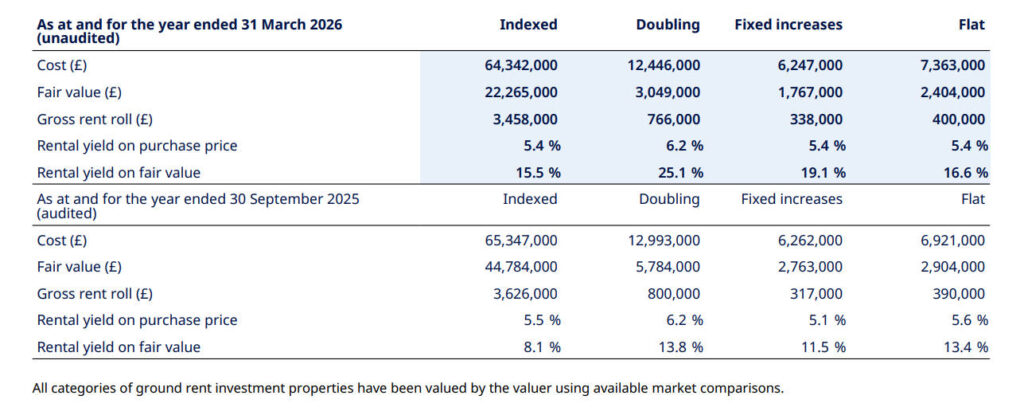
This table shows the breakdown of each ground rent type within the portfolio as of March 2026, and the respective fair value and yield for each type. As you can see, all yields on fair value are in the double digits.
Source: schroders.com
It is significant that such as large fund has been down valued after the announcement by independent valuers to such a great degree. It is evidence of market uncertainty, and the fact that investors today demand a higher rate of return for their investment to offset risk of having their ground rent capped from this bill.
What’s next?
Leaseholders, and those of us acting for leaseholders, must ensure the premium negotiations reflect current market conditions. Given the proposed legislation and the uncertainty they create for landlords, this is an excellent opportunity to seek lower premiums.
Clearly, freeholders will be resistant to this change. We will likely require a determination before the effect of the cap is fully reflected in enfranchisement calculations.
Related posts:
 Are you overpaying for your lease extension?
 Woman signs up to doubling ground rent to extend lease on £70,000 flat. Is it now sellable at all?
 Informal lease extensions are pure poison!
 Oh, dear! Long Harbour private equity speculators buy freehold where ground rent FALLS from £250 to £143
 The dirty tricks played with formal lease extensions
 Freeholder Israel Moskovitz’s legal ‘blunderbuss’ backfires over Cresta Court RTM in Supreme Court



















I couldn’t passed your the first couple paragraphs…. The comparison you are making sounds to me like … Let’s say you invest in a plantation with X return but now the slave in the plantation would be Fred reducing your income next to 0… What is inherently wrong is just wrong. Please check your values
It hasn’t become Law yet and is still only at draft stage of Commonhold & Leasehold Reform Bill. Meaning nothing has been set in stone yet, so how can it be reflected in a Lease Extension right now and since 27/01/2026. All you can say to attract a buyer is that Government are working on a major reform of Leasehold in favour of Leaseholders, and if they want to buy it now then split the cost of a Lease Extension between seller and buyer, but all becomes extremely complicated because Freeholders do not like you doing that, and Estate Agents can use the situation to their own advantage. Plus if Leasehold becomes Commonhold there will be no Lease to extend = zero cost.
the transition for existing lessees from leasehold to commonhold will not be free of charge, the reversioner’s interest in the property would have to be bought out, and the costs involved in set up of a new commonhold association borne. It remains to be seen whether for existing estates this will be a gigantic flop as per the first iteration of commonhold. This is particularly so where leaseholders are reasonably content with the existing estate management
The Government’s proposal to cap ground rents at £250 is a highly provocative stance\. It will inevitably be challenged, potentially all the way to Strasbourg, by the funds that hold large portfolios of index\-linked ground rents\.
As we have seen, the Government will not want to implement legislation until it has confidence that there is no realistic prospect of substantial compensation having to be paid\. If it sticks with the proposal in its current form, it is difficult to see how legislation could be delivered before the next General Election\. At the same time, the Government clearly needs to ingratiate itself with leaseholders, who represent an important demographic\. Some form of watering down of the original proposal would therefore seem inevitable\.
A much more proportionate solution would be to cap each ground rent at the level at which it originally commenced, with subsequent reviews limited to the lower of RPI or the increase provided for in the lease\. This would immediately address the problem of the genuinely pernicious rents without effectively confiscating legitimate existing income streams\.
Leaseholders could then be given an unrestricted right to extend their leases while retaining the existing ground\-rent terms\. This would dramatically reduce the cost of a lease extension, because there would be no need to compensate the freeholder for the loss of the ground\-rent income\. At the same time, it would avoid unnecessary conflict with freeholders’ legitimate property and income rights\.
Such an approach would tackle the problem the Government is seeking to solve, while being considerably more proportionate and much less vulnerable to challenge\.
Though Daneholme Court is interesting (a client of mine bought it), it is part of a very incomplete story. I would note you only include the hammer price and do not account for the auction fees, or the contribution to the sellers costs, or the unrecoverable arears, in your calculations, which ofcourse a commercial buyer would.
By contrast Lot 203 Holly House Brentwood (Allsops 18/09/2026) has a Ground Rent of £4,454 (per adendum) and 2 shorter lease flats (£48 yrs remaining- currently valued in an auction at £15k each) for £150,000 plus auction fees of £2,000 plus a contribution to the sellers sale costs (say another £2,000) and you get to a figure of £124,000 for the existing long leashold ground rents or 28% or a return of 3.6%
The auction house says its a 2.97% yield and three short leases. I assume the buyer has seen some extra income streams that make them thinks its worth a punt. I think I can guess but it may be another example of why we need to get rid of the toxic leasehold system ASAP
Other sales gave a yield of over 10% with one at 16.67%. As you know the landlords have been grossly inflating their estimate of property values. A pyramid buying system rather than a pyramid selling system?